
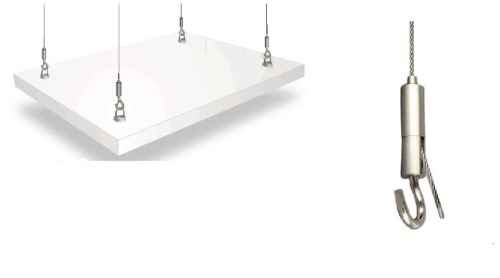
Complete Guide on cable Grippers
Cable adjuster or gripper work wonderfully when it comes to pulling or tensioning for Hanging Application
Cable adjuster or gripper work wonderfully when it comes to pulling or tensioning for Hanging Application. They are light and easy to carry around to work sites and can be used conveniently once the cable pullers are placed in the correct capacities. Cable grippers are considerably put to use in various industries and are also available often for daily applications.
How To Use Cable Grippers?
As the name clearly suggests, a cable adjuster or gripper is a wire rope gripping tool that enables users to pull a load and create tension upon the wire rope which is put through it. Wire rope requires tightening not only in industry but also for regular jobs around the home like tightening of wire rope fencing or gardening. In situations like this, cable grippers are really helpful as they enable simple, quick, and easy removal of slack from the wire rope, creating a structurally strong build compared to what it would have been if it was manually tightened.
Cable grippers are mostly used as they provide safety. Tightening or creating tensioning in wire ropes is a dangerous job and therefore using the best possible safety tool is of utmost importance. Good quality cable grips offer a firm and a non-slip grip without causing any wrecking to the wire rope and are quality tested to meet tough safety standards and regulations.
Cable Grips are Not Manufactured same way:
Cable adjuster or grippers are available in a variety of options and each one of them has its own set of pros and cons which we shall discuss in this part of the article.
The most commonly used cable gripper does not provide a “grip” per se but is almost like a half-hitch method that is attached to the last couple of feet of the cable. This type works superbly if the pull is not that difficult, and the tensioning is not too tight. However, one difficulty that may arise is that the cable may end up bowing if a large amount of tension is applied creating pressure on the cable head and making the head drag.
The second type of cable grip available is a wire mesh which is often commonly referred to as Kellems Grip. It is more like a braided wire sleeving grip that comes with a pulling eye. This function based on the “Chinese Grip” principle to lock it down on the cable once force is applied and distributed on it longitudinally. Although these grips are extremely powerful, they too have a few drawbacks like the head itself takes up a significant amount of space because of the grip profile.
cable grippers and its application
wire cable gripper has broad application in increasingly being used for mounting building services components in commercial, public sector and industrial buildings. There are major advantages of flexible positioning and installation productivity benefits compared to traditional system.
Building services – both in terms of plant items and distribution systems such as pipework, ductwork and cabling – are currently positioned within buildings using a range of methods and materials. The majority of services are suspended from above using support systems comprising three major components; the fixing which is attached to the building structure, the suspension element itself, (the length of which can be adjusted to position the service at the right height), and the attachment or sling that is attached to or around the service.
Traditionally the suspension element has been a rigid component, usually threaded rod. While this is usually in tension, it also provides some resistance to compressive forces, helping to ensure the rigidity of an installation. Wire rope suspension elements are only strong when under tension and provide no resistance to compressive or bending loads, although careful design (for example setting wires at angles) can usually provide suitable restraint. In addition, most threaded rod systems (fixings, threaded rod and associated fittings) are significantly over specified for most applications, allowing considerable freedom of installation methods. Wire rope systems tend to be more closely specified against the design load and could be overstressed if incorrectly installed. However the time taken for installation is dramatically reduced compared to that for threaded rods, significantly reducing installation costs. The other significant difference is that where threaded rods are usually mounted vertically, wire rope systems can easily be installed at an angle. This significantly increases the range of suspension points that can be used.SCOPE OF WIRE ROPE CABLE GRIPPER SUSPENSION:
Wire rope suspension can be used to support a very wide range of loads and objects. This publication deals with applications within the following criteria:
• Internal or semi-internal applications (not external)
• Metal wire rope suspension (not rods or plastic ropes)
• Moderate loadings (up to 1 tonne working load per suspension point)
• Static fixed length permanent or semi-permanent suspension (no lifting).
Almost any piece of building services equipment could be suspended using wire ropes, such as:
• Fan coils and air handling units
• Radiant heating and cooling emitters (radiant tubes, radiant panels, chilled beams)
• Cable trays
• ceiling grids
• Luminaires and lighting systems
• Ductwork

